


Last week, we talked about how Vegas began as a humble, dusty railroad town, springing up from the desert floor with silent-era movie theaters, a raucous district of ill-repute, the first use of neon signage, and the building of the Hoover dam, the catalyst that would spur major development, Vegas had soared through the roaring teens and 20s and started to put itself on the map. But what was next? The 30s would see continued growth, including legalized gaming, the birth of the modern showroom and casino complex, the continual inflow of Hollywood stars, and the first true headliner in the Vegas Valley. The sun was rising on what would later become known as Sin City, and things were starting to get exciting.
Gambling on a Dream
Fresh from the completion of the Hoover Dam, the Las Vegas valley had experienced an influx of residents and pleasure seekers alike. Car culture was flourishing, and Las Vegas became an important stop along what was then known as Highway 91 (later “The Strip”) for travelers in the desert Southwest. With prohibition still in full swing, no one in Vegas seemed to much mind as the town had more than its fair share of saloons and speakeasies. The conventional wisdom at the time was that the solution was clearly not to stop serving booze, but merely to not be too brazen about it. Like, just don’t have a sign up and you were A-OK. So, the desert watering hole began to earn a place of special significance to travelers looking for a fun pit stop amongst the sagebrush. Enter stage right: the Pair-O-Dice nightclub in 1930. Welcoming travelers with its mission style Spanish architecture, fine dining served on china, linens and lace, games of chance, and speakeasy booze (made from a copper still under the quail pen) owners Frank and Angelina Detra may have unwittingly kicked off the original Vegas experience. The Pair-O-Dice may have been on the outskirts of the city of Las Vegas at the time, but that didn’t seem to dull its appeal or success at all. And even though the club opened before both gambling and alcohol were technically legal, the Pair-O-Dice seemed to be able to brush off any skirmishes with the law. In fact, when neighboring establishment The Red Rooster got raided, the Pair-O-Dice was able to keep operating due to Frank Detra’s friends in high places, namely one Al Capone. Good to know the right people, right?
Soon, worrying about being busted for illegal gaming would be a thing of the past. Clearly, gambling was already a popular pastime in the wild west, and perhaps taking a page from the “if you can’t beat ‘em, join em” the state senate passed legalized gambling on March 19, 1931. Given how synonymous gambling is with Las Vegas now, you would think that at the time, this would have been huge news. Amusingly, this legalization, while important, didn’t have the initial earth shattering impact you would have expected. In fact, it didn’t even warrant top billing on the front page of the Evening Review, one of the newspapers at the time. Instead, that headline went to the opening of a local hospital. Still, gambling was now legal, and the proverbial floodgates were open.
Now, while this podcast is primarily about entertainment history, we will quickly dive into a little gambling history too, as the legalization of gaming changed the face and reputation of Las Vegas permanently. And, the flourishing of casinos and resorts would start to drive the entertainment scene as establishments began to realize that the draw of entertainers would keep people spending their hard earned dough.
So let’s imagine you live in downtown Las Vegas in the 1930s for a minute. In 1930, the town had only 5,000 people total, and life was centered around Fremont Street in downtown. So if you lived here, it’d be very likely that you knew most people walking down the street. Jazz would float over the airwaves from the brand new radio station, KGIX, which would broadcast daily news and feature local live musicians. Walking down Fremont Street, you’d be mesmerized by the neon lights, which were beginning to take over downtown. Some would call it a “neon battle” with each new bar, club or gaming establishment upping the ante for their share of attention on the small desert street. You’d be reading about the day’s events in one of the two competing newspapers, the Las Vegas Age, and the Review Journal, which was a lot of media outlets for a small town at the time. If it was a payday, workers from the Hoover Dam project would flood the city streets from neighboring Boulder City (which did not allow alcohol or gaming of any type), wanting to spend their hard earned dollars and have some fun. And now, with gaming officially legal in Nevada, there was fun to be had.
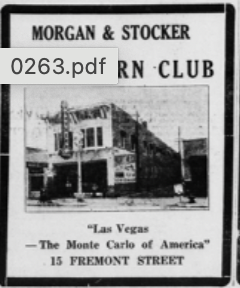
The first gaming license in Nevada was issued in 1931 to Ms. Mame Stocker for her family’s establishment called the Northern Club, located at 15. E. Fremont, in what now would be part of the Fremont St. Experience. Given that prohibition wouldn’t end for another 2.5 years, the Northern Club “only sold soda pop” to those who wanted to partake of games of chance. Uh huh. As usual, nobody really believed in prohibition or enforced it.
Now, I think it’s pretty cool that the first gaming license was issued to a woman. I like to think of that as pretty progressive and open minded for the time, and I feel like I would have liked to know Mame. Not only was the Northern Club very successful, but Mame was definitely a mover and shaker in town, which is even cooler. She had a home in the most fashionable neighborhood at the time, her parties were covered in the society pages and she lived to be nearly 100.

Quick sidebar: For those who are interested in cemeteries, she is buried in the Woodlawn Cemetery, which is one of the original cemeteries in town and where many influential early Las Vegans are buried. While she does not have a headstone to visit, her son’s grave is marked. I definitely recommend a Woodlawn Cemetery tour if you are like me and enjoy the intersection of the morbid and the historical!
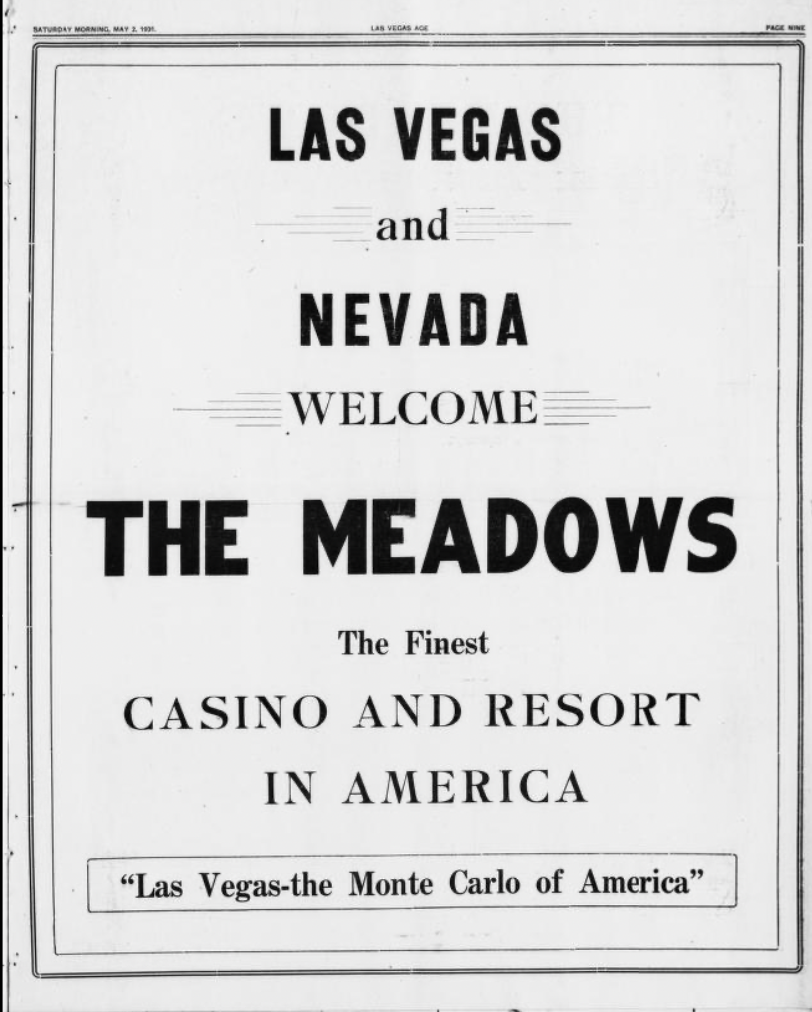
The Northern Club may have been the first legal gaming establishment, but it clearly wouldn’t be the last. The aforementioned Pair-O-Dice Club officially got its gaming license in May 1931, and remained a popular destination for both dining and entertainment. That same year, another important destination opened, which would take the idea of the Pair-O-Dice and really expand it. A pair of bootlegging brothers, the Cornero Brothers, realized that running booze from Canada to LA could have a more lucrative pitstop, and had a vision for glamorous new desert digs. In May 1931, ‘The Meadows’ became the first full fledged supper club and casino, what we would now know as a true resort, with elaborate operations, entertainment, and no need for customers to leave the property at all. In a full circle moment, the property was named after the English translation of the town’s name, Las Vegas, which had come from settlers on the Old Spanish Trail.
Promising “elegance without stiffness and luxuriousness without extravagance,” The Meadows opening had a mean PR campaign, including a 4 page spread in the Las Vegas Age, filled with glossy photos of all of the lavish appointments for the new property.
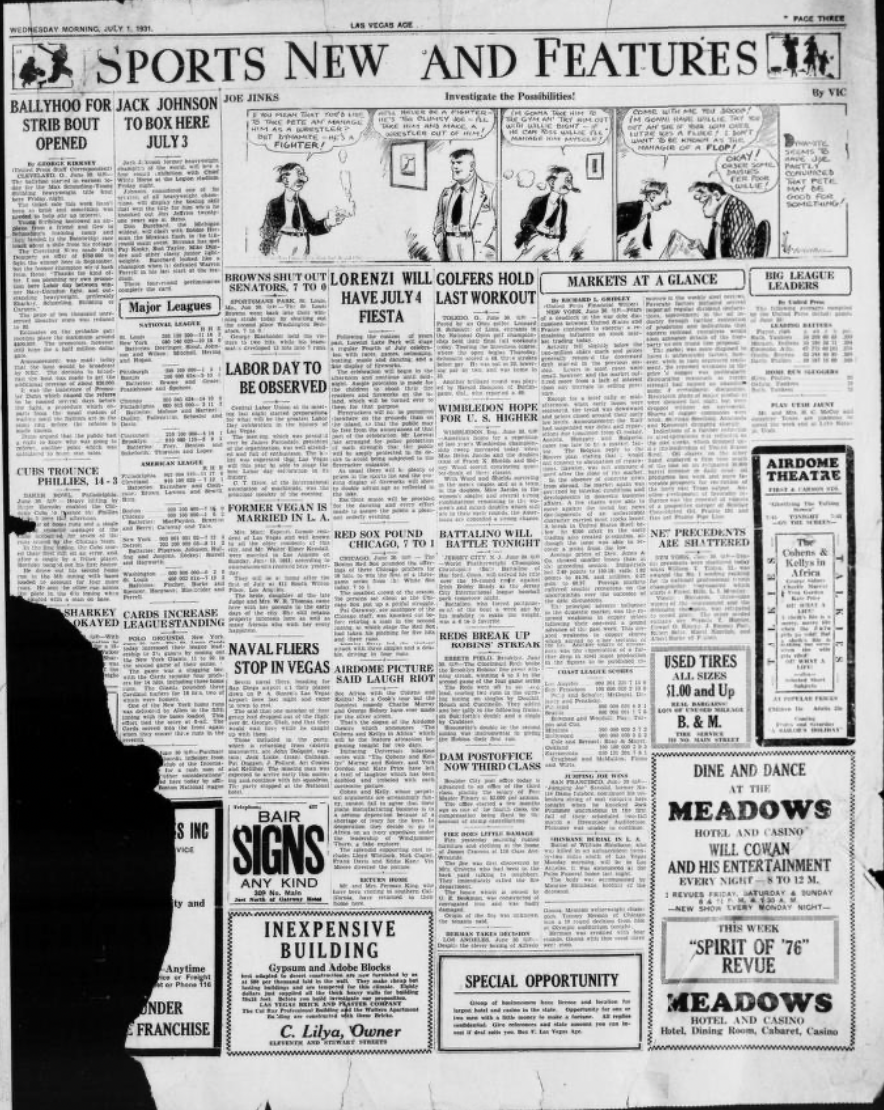

Not only was The Meadows glamorous, but they boasted glamorous entertainment too. In the early 1930s, a little vaudeville act performed at The Meadows, featuring a young talent then known as Frances Ethel Gumm. Now, for anyone who likes entertainment history, you probably already know that little Frances would later adopt a stage name and become one of the greatest movie stars of all time: Judy Garland. However, at the time, Frances, and sisters Dorothy and Mary Jane were simply known as “The Gumm Sisters” and they performed their song-and-dance vaudeville act all over the country. That was even before the group changed their name to “The Garland Sisters” in 1934, when it was becoming clear that Judy’s talent was eclipsing the other sisters’ star power. But, neither The Meadows and the Gumm Sisters trio would prove to be permanent. Only a few months after opening, The Meadows burned to the ground when a fire started on property, and having been built outside the city limits, the City of Las Vegas fire department refused to put out the fire. The Meadows did rebuild for a time, changed hands many times, and permanently closed in 1942. And years later, in an unrelated incident, sister Mary Jane Gumm passed away in May of 1964 in her Las Vegas home, some say under “unusual circumstances.”
It wasn’t just the Pair-O-Dice and The Meadows that were starting to become entertainment destinations. In 1932 in downtown Las Vegas, the Hotel Apache hotel, helmed by Pietro Silvagni, who cleverly observed that there were no luxury accommodations in town, and that there was a great need for more elevated establishments with the burgeoning tourism from the Hoover Dam and auto travel. The Hotel Apache, which you can still stay in today and is part of the Binions property in downtown Las Vegas, was the first property with air conditioning, private bathrooms in every room, automatic locks on the hotel room doors and drumroll please: an electric elevator. Fan-cy! While that may seem quaint now, this would have been incredibly exciting and luxurious for the time in the small desert town. It’s said that locals would visit the Hotel Apache just for the novelty of riding the elevator up and down the 3-story building.
The Wild West Era
The Hoover Dam project had begun in 1931, and it was a major entertainment destination for travelers. As mentioned, car culture was flourishing, fuelling a construction boom of “auto courts,” or what we would now call motels. In 1932, 92,000 tourists came to witness just the construction of the dam. Even Clark Gable, the biggest movie star in the world at the time, came out to see the dam. But soon, the dam project would be over, and that economic engine was going to need to be replaced by something else. Vegas was about to enter its Wild West era. In 1935, the national attention that came from the dam’s radio broadcast dedication by president Franklin Roosevelt turned the spotlight of millions of listeners to the small desert town. So how would Vegas capture and keep that attention? By rebranding itself, of course. Capitalizing on the immense national popularity of western movies and books, the Chamber of Commerce took the ball and ran with it, and recreated the image of Las Vegas as the last great manifestation of the Wild West: freedom, frontier, and fun. Marketing campaigns leaned into the natural beauty of the landscape, the long, sun-filled days, and the spirited Wild West lifestyle. To reinforce this new persona, the Helldorado Days were breathed into existence. Copying an existing event from Tombstone Arizona, carnival and pageant producer Clyde Zerby was hired to produce the event in Las Vegas. He pulled out all the stops, including renting costumes and props from a friend at Paramount Pictures. The four day event included pageants, rodeos, whiskers competitions, and more. The marketing message “Still a Frontier Town” was plastered all over town, and locals got on board wholeheartedly. If you look at historical photos from this time, you can tell locals enjoyed this as much or more as the tourists that the event was meant to attract: they are dressed to the nines in Western gear including Davy Crockett caps and all, riding burros into the bars.
Tinseltown Takes Over
But it wasn’t just the Wild West era that Vegas was moving into, it was about to be the Hollywood era. Fueled by the allure of the rugged dude ranches and burgeoning entertainment scene, Tinseltown and Las Vegas started to cozy up to one another. Film production started to become more common, including 1934’s RKO picture “The Silver Streak,” and the 1936’s Warner Bros. pic with a rather uncreative name: “Boulder Dam.” And in the 1930s, one of the most famous movie stars in the world moved to the Nevada desert, none other than “the It Girl,” Clara Bow. Bow was a silent screen siren who eventually wound up successfully making the jump into talkies later in her career. She got her namesake from appearing in the iconic 1927 movie “It” with “it” being a moniker for sex appeal, charm and vivaciousness. By the early 1930s she had appeared in dozens of films, and was ready to retire from show business. On Dec. 3, 1931 in Las Vegas, Clara married the famous western actor Rex Bell, and the two took up residence in his Searchlight, NV ranch, living an idyllic frontier lifestyle together. The Walking Box Ranch, as it was called, paid homage to their years on the screen by being named after the type of cameras that were used in silent films at the time. Ever the gracious hosts, they filled their home with celebrities from their time in Tinseltown, including Clark Gable and Carole Lombard, Errol Flynn, Lionel Barrymore, John Wayne and even a young Clint Eastwood. But it wasn’t just hosting parties at their home that Clara and Rex were up to.
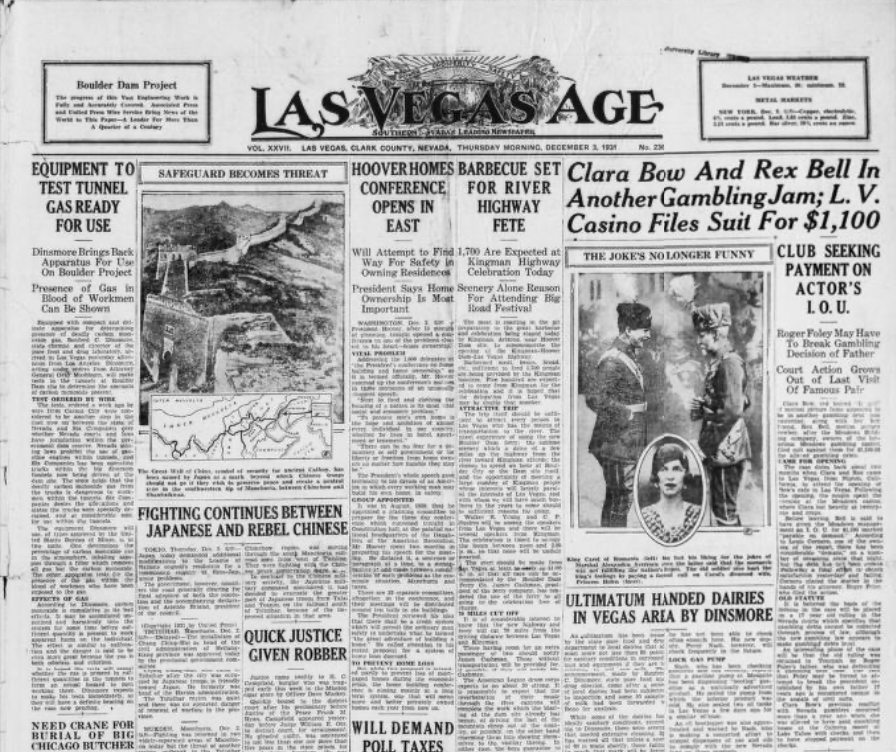
In perusing old Las Vegas Age articles from the early 1930s, it seems Clara racked up over $1,000 in gambling debt to the aforementioned Meadows Hotel, which seems to have been quickly settled following the press this debt received.
Clara and Rex also hosted a huge 4th of July event in their new home town of Searchlight, which boasted horse racing, bronco busting, fireworks and of course, appearances by their famous movie star friends.

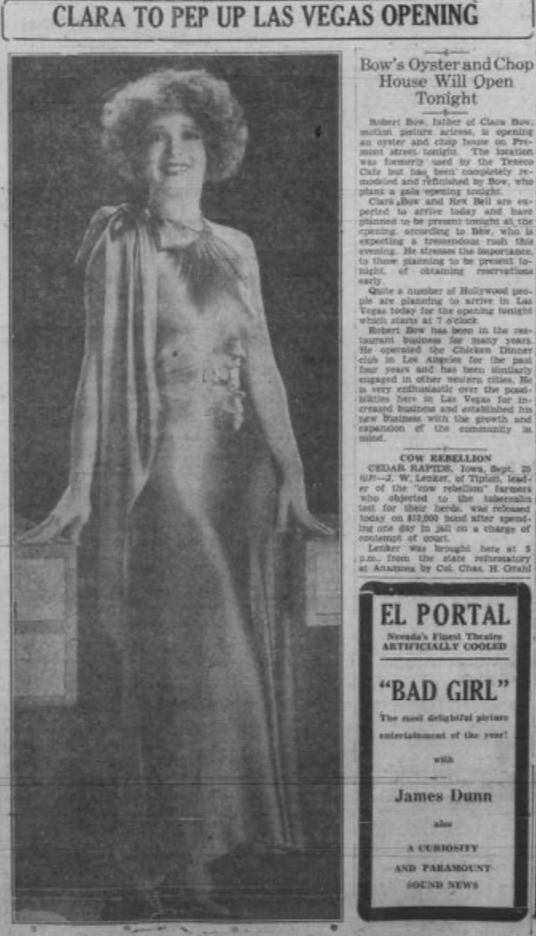
In those newspaper articles, I also came across a mention of Clara attending the opening of a cafe in town a few month earlier, which triggered another fun deep dive into the Hollywood-Las Vegas connection.
I discovered that Clara’s father, Robert Bow, opened a restaurant in September 1931 in downtown Las Vegas, called the Robert Bow Oyster and Chop House.
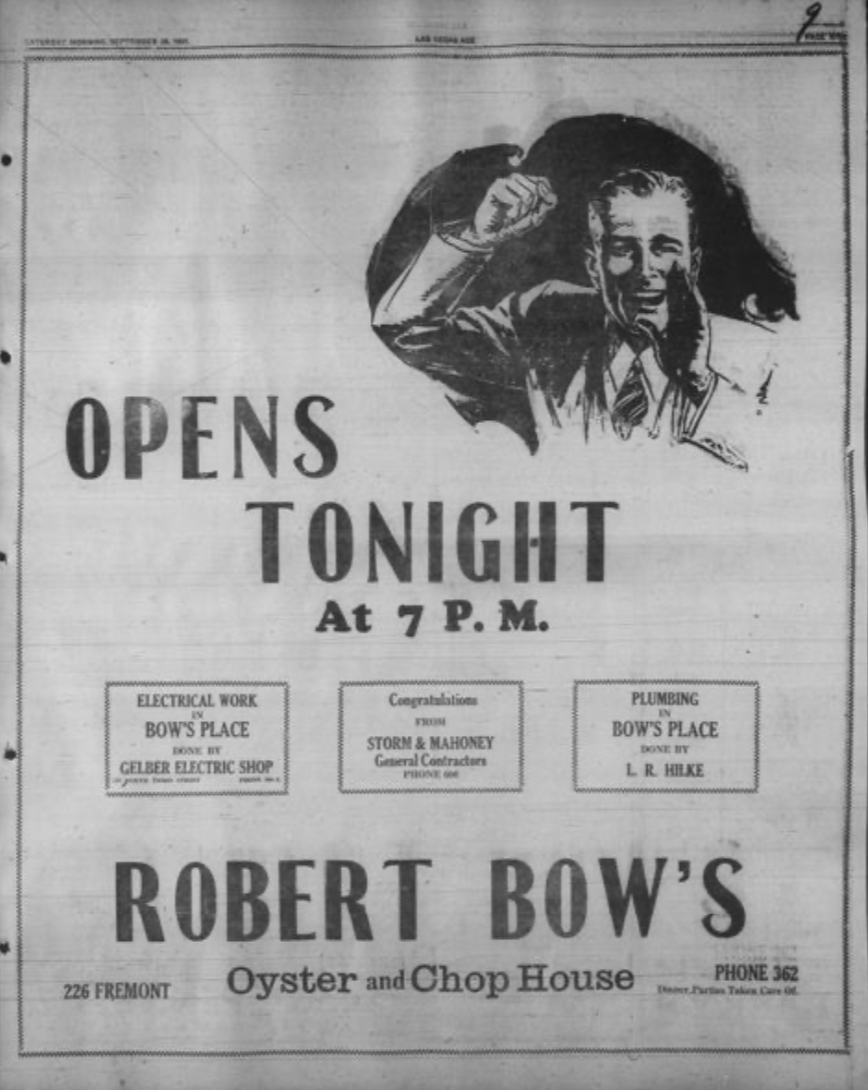
Naturally, Clara attended the opening of the restaurant to bring some of her star appeal. From what I can tell it was located at 226 Fremont Street, which would be about where the 4 Queens casino is now.
Easy Come, Easy Go
The 1930s brings another unique facet to Las Vegas’ reputation: easy access to marriages and divorces. In March of 1931, the state of Nevada relaxed the rules for both nuptials and breakups. In most other states at the time, getting hitched came with a lot of hoops to jump through, including blood tests, a certification of health, and a waiting period. Great-Depression-era Nevada realized that loosening up these requirements may help draw business away from other states. Nixing those requirements, plus making marriages available 24 hours a day, 7 days a week (including Sundays and holidays!) which was totally unheard of anywhere else, gave Nevada a huge advantage over other states for matrimonial share of wallet. And new direct flights and increased access via train travel made a trip to Las Vegas even easier than ever before. And the same could be said for divorces – in the same year, Nevada changed the divorce requirements from a painful 6 months to a short, 6-week “residency,” which allowed tourists to lick their wounds, but have some fun too. Divorce-tourism blossomed in the form of dude ranches where one could swim, fish, horseback ride, enjoy the sunshine, and of course, gamble. After all, the pain of a breakup is significantly lessened when there is fun to be had! For my Las Vegas locals, two divorce ranches are still able to be visited today, and are historical parks: Lorenzi Park (then known as Twin Lakes) near downtown Las Vegas, and Floyd Lamb Park at Tule Springs, in the northwest part of town. In walking around these two parks now, you can still see the old bungalows and lakes where tourists would come to rest up and enjoy their R&R amongst the sagebrush.
Hollywood soon began to take notice of this easy-come, easy-go attitude to marriage and divorce. But the breakup that really put Las Vegas on the map was the stuff of Hollywood legend: the divorce of Ria and Clark Gable in 1939. Clark Gable was THE ultimate leading man at the time, as 1939 is the year that the box office blockbuster Gone With the Wind comes out. It is nearly impossible to overstate his star power at this time, so his divorce from Ria was big news. Ria came to Las Vegas to take what had become known as “The 6-Week Cure,” and she was ready to have some fun while she did it. Realizing they had a gold mine on their hands, the Chamber of Commerce capitalized on Ria’s fame, and took photos of her doing absolutely everything they could get their hands on: frolicking on Lake Mead, enjoying Mt. Charleston, and staying at the glamorous Apache Hotel mentioned earlier in this episode. The chamber serviced this story out to all the newswires, and soon Las Vegas was on the map as the place for a glamorous and quickie divorce.
With the separation from Ria underway, Clark was ready to move on to be with his new love and Tinseltown siren Carole Lombard. The two would later marry and spend three years together. However, in 1942, Carole’s untimely death in an airplane accident in the mountains outside of Las Vegas would cause Clark to hole up at the Pioneer Saloon in Goodsprings, Nevada, while he waited for the findings from the wreckage. It’s a tragic, yet fascinating, story of Hollywood legend, and I plan to devote more time to it in another episode, so stay tuned.
But it wasn’t only Clark and Ria that came to Las Vegas for the liberal marriage and divorce laws. In the 1930s, a bevy of Tinseltown elite travel out to the desert oasis of Las Vegas for their own nuptials. In the early thirties, Superstar “It Girl” Clara Bow, mentioned earlier in this episode, married Rex Bell in Las Vegas, as did Tarzan author Edgar Rice Burroughs. Famous actor Bela Lugosi, THE actor you think of when you think of the character Dracula, also eloped to Las Vegas, with his bride-to-be Lillian.
Vegas was beginning to boom, and the influx of the glamorous Hollywood set was just the beginning. The 30s would close out with Vegas firmly in the public lexicon as a tourist mecca. In 1939, 600,000 tourists visited the valley, compared to 500,000 that year for Yosemite and Yellowstone combined. The sun was rising on what would later become known as Sin City, and the only place to go now, was up.
Show Notes
KCLV The City of Las Vegas The 1930s Documentary
Las Vegas, The Entertainment Capital, Donn Knepp
Vegas: Live and In Person, Jefferson Graham, Abbeville Press
UNLV Special Collections, Walking Box Ranch Collection
LAS VEGAS AGE, VOL. 27, NO. 236 (1931-12-03)
 On With The Show
Leave a comment